但紧接着,美国继续大行保护主义,美国认为中企通过在柬埔寨、马来西亚、泰国和越南这四个东南亚国家组装太阳能组件来规避长期存在的关税。
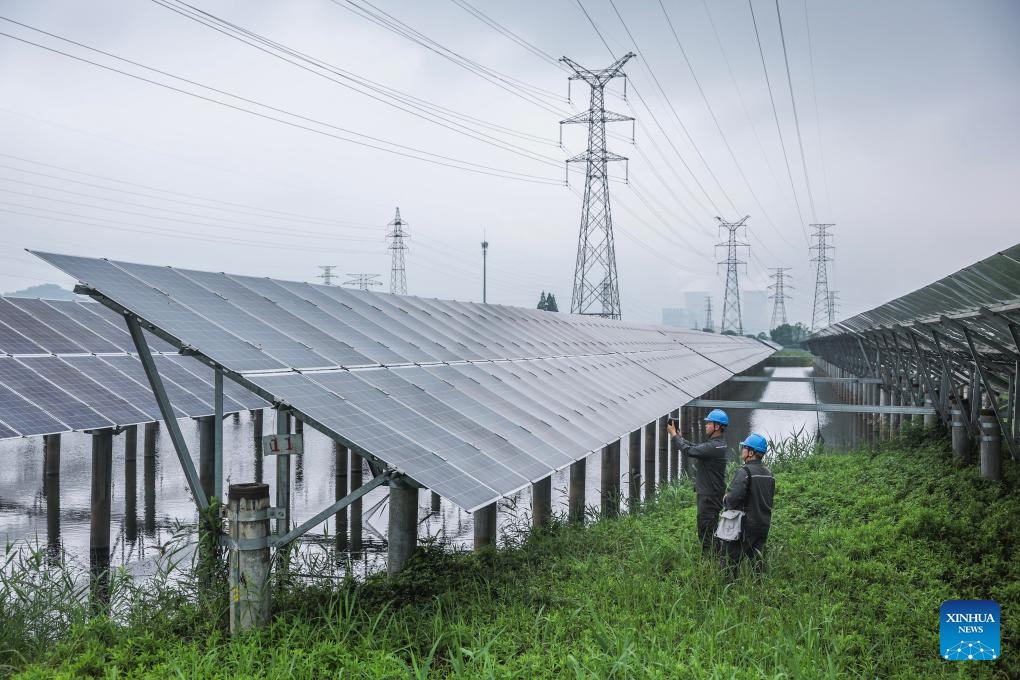
Staff members of State Grid Huzhou power supply company conduct inspection on the photovoltaic lines and equipment at a photovoltaic power station in Changxing County of Huzhou City, east China's Zhejiang Province, May 27, 2026. In recent years, State Grid Huzhou power supply company has been constantly promoting the upgrading of the county-level power grids, advancing the integration of renewable energy sources into power grids, and endeavoring to construct a safer, greener and smarter power grid. (Photo: Xinhua)
Eight Chinese leading polysilicon producers have issued public pledges to stop selling solar products below a cost benchmark, in a fresh industry effort to curb "involution-style" competition and support healthier pricing in the country's photovoltaic supply chain, the Shanghai Securities Journal reported on Friday.
Industry experts said that this move will not only help stabilize profits across the sector, but also promote the Chinese photovoltaics (PV) industry's shift toward high-quality development.
The eight companies jointly committed that the selling prices of all photovoltaic products, including tender bids, must not fall below the corresponding cost calculated under the group standard General Principles for Cost Accounting Models in the Photovoltaic Industry. Any sales below full cost must be "immediately stopped and corrected," according to the report.
The pledge was signed in Shanghai on Thursday by the companies, including four listed companies — Tongwei Solar Co, GCL Technology Holdings Limited, Daqo New Energy Co, Xinte Energy Co. The other four companies are Asia Silicon (Qinghai) Co, Xinjiang East Hope New Energy Co, Qinghai Lihao Qingneng Co, and Xinjiang Goens Energy Technology Co.
Together, the eight companies account for more than 90 percent of China's effective polysilicon production capacity, the Shanghai Securities Journal report said.
Under the initiative, the companies also agreed to accept supervision and inspections from market regulators at all levels and to strengthen mutual oversight. If they discover illegal below-cost sales, they are required to report the issue and file complaints with the industry association and the State Administration for Market Regulation (SAMR).
In addition, the firms committed to strictly implementing China's new energy-consumption standards and to proactively eliminate outdated, high-energy-consuming production capacity.
The move comes just one week after the SAMR held a solar industry price-compliance meeting on July 31, urging solar PV companies to strengthen price compliance and shift competition from price to quality.
It instructed companies to strengthen cost accounting, establish and improve price compliance systems, and carry out comprehensive self-inspections and corrective actions, according to the Xinhua News Agency.
Industry experts welcomed the initiative, saying that years of excessive competition have pushed many photovoltaic firms into losses, which is harmful to the industry's long-term development.
China's PV industry is mired in severe low-price competition, with profit margins squeezed along the entire value chain and many firms operating at a loss, Xiang Ligang, director-general of the Zhongguancun Modern Information Consumer Application Industry Technology Alliance, told the Global Times on Friday.
Xiang added that the initiative could help ensure more reasonable revenue and profit levels, which are essential for sustainable industrial development. The move also reflects a broader shift among Chinese firms toward greater coordination in responding to market pressures.
Although the industry also faces external challenges, including US tariffs on polysilicon-related products, Xiang said the main purpose of the initiative is to improve the sector's own development model rather than simply respond to foreign trade measures.
China has launched sweeping efforts to curb "involution-style" low-price competition and accelerate the phase-out of outdated industrial capacity. China's Ministry of Industry and Information Technology on July 3 held a symposium for manufacturing enterprises, focusing on accelerating the high-quality development of the photovoltaics industry, according to the Xinhua News Agency.
The symposium called for efforts to comprehensively deal with the problem of disorderly price competition in the photovoltaics industry in accordance with laws and regulations, as well as efforts to guide enterprises to improve product quality, phase out backward production capacities in an orderly manner and achieve healthy and sustainable development, Xinhua reported.
。
由此可见,美国对中国企业打压就是要到极致的底部,在太阳能电池板上,华盛顿认为中国现在取消了补贴,但太阳能光伏部署依然很快,预计将在2024年实现2030年国家风能和太阳能光伏装机目标,比计划提前六年。
在经历了之前全球价格下跌之后,新一轮的周期中,太阳能电池板模块成本明显下降,但欧美和中国的差距进一步拉大了——2024年第一季度,中国的平均成本为57美元,而美国的平均成本为127美元。
而这些商品绝大多数依然是中国企业主导,因为无论怎么算,欧美的成本依旧要比中国高,尽管美国有补贴也一样,况且大部分美国企业不能全部享受,因为要求太高,几乎就是业链上游都在美国生产,才能拿到。


